
What actually happens to your resume after you apply?
97.8% of Fortune 500 companies used a detectable Applicant Tracking System in Jobscan's 2025 audit of all 500 career pages — meaning nearly every large-company application is parsed by software before a human recruiter sees it. Understanding what these systems do and how to overcome this obstacle is often the difference between remaining invisible and booking your job interview.
An Applicant Tracking System (ATS) is software that collects and screens job applications before a recruiter reads them. It works in three steps: it parses your resume into structured fields (name, titles, dates, skills), stores that record in a searchable database, and lets recruiters search and filter by keyword, title, and credential. The ATS almost never rejects you outright — but if your resume parses badly or lacks the terms recruiters search for, it simply never surfaces, and no human ever reads it.
The adoption figure and screening behavior above are sourced in our State of ATS 2026 study — every claim linked to its named original source.
First, the myth: the AI robot isn't rejecting you
The most common fear about ATS screening — that an algorithm reads your resume and throws it away — is mostly wrong. Outside of hard knockout questions, the ATS doesn't reject anyone. What it does is subtler and, in a way, perhaps even worse: it turns your resume into rows in a database. If the recruiter's search doesn't match those specific rows, your application just sits there, unread, forever. It's not that somebody rejected you. It's that nobody even saw you in the first place.
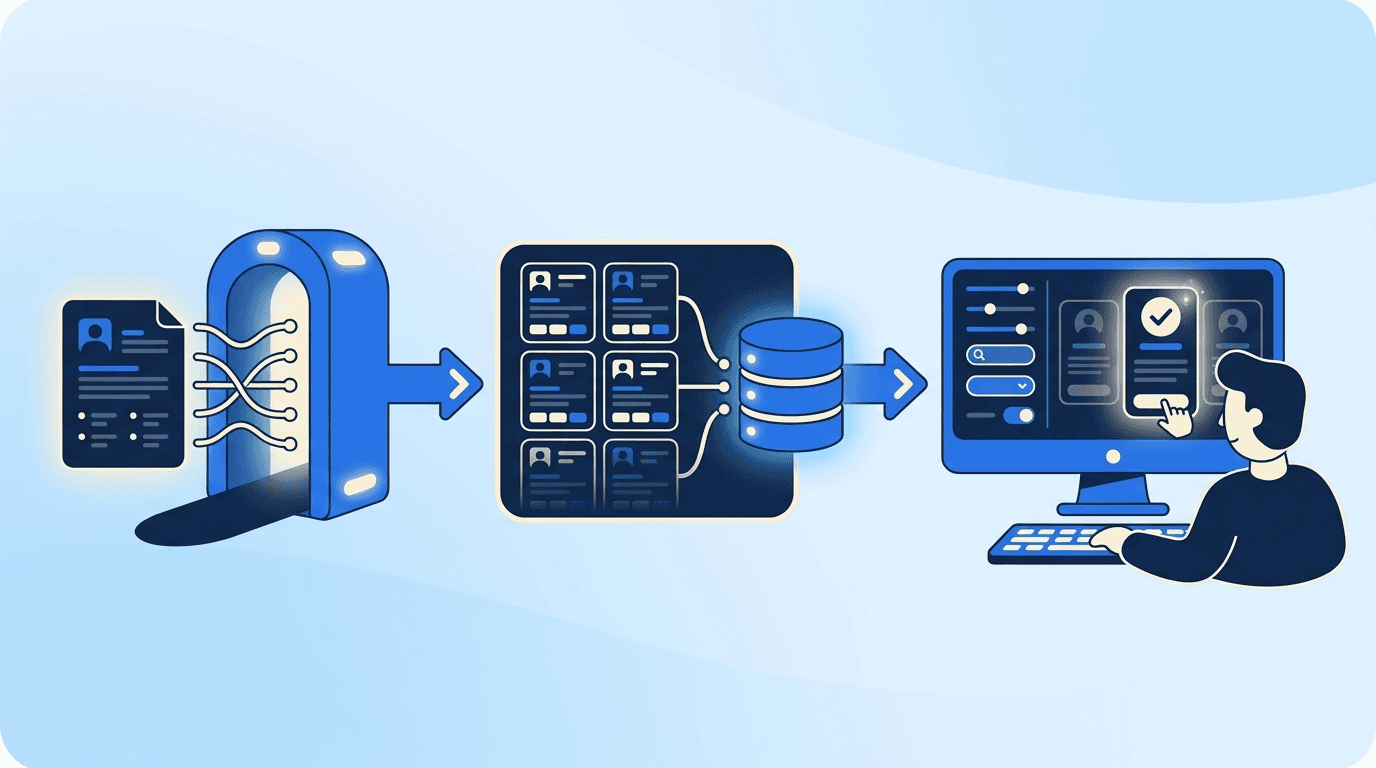
Step 1 — Parsing
The moment you submit your resume, the ATS software extracts text from your file and maps it into structured fields: name, titles, employers, dates, skills, education. This is where design-heavy resumes die quietly — tables, columns, and graphics scramble the extraction, so your ten plus years of experience land in the database as fragments. Clean, conventional structure isn't boring here; on the contrary, it's machine-legible.
We didn't take this on faith — we measured it. Our ATS Parse Benchmark runs a published corpus of test resumes (tables, columns, header-borne contact details, graphics, unusual headings) through a real parsing path and publishes exactly what each structure loses — every figure computed by a script anyone can re-run.
Step 2 — The searchable index
Your parsed resume joins hundreds or thousands of others for that posting — and often the company's entire historical applicant pool. It's now a search index, exactly like a private Google search for job candidates. What you wrote matters less than what's searchable: exact certification names, tool names, methodologies, and the industry phrasing your specific field uses.
Step 3 — Recruiter search, filters, and scorecards
A recruiter with hundreds of applicants doesn't read them in order — they search and filter: by keyword, title, credential, location, sometimes a match score. The candidates who surface to the top of these filters are the ones who get read; everyone else doesn't even exist. This is why role-specific keywords beat generic "action verbs" advice. For example, a QA Engineer is searched by automation frameworks, a Cloud Architect by platform certifications, an IT Project Manager by PMP and PRINCE2. It's exactly the same database but with completely different search criteria.
Where we come in
By rewriting your resume and LinkedIn profile, we can optimize both so everything works in your favor: structure that parses cleanly, and keywords that match to how your exact job category is searched for within your industry. Verified by an expert ATS reviewer and delivered to you in 72 hours.
Get startedWant the 2026 update? Read How ATS Screening Actually Works in 2026 for what's changed: AI-flooded applicant pools, platform-by-platform differences, and what still gets you found.
ATS questions, answered
Almost never. Auto-rejection typically only happens on knockout questions (like work authorization). What actually happens is subtler: your resume gets parsed into a database, and if it doesn't contain the exact keyword terms recruiters search for, it simply never surfaces to the top. You're not rejected — you're simply kept invisible.
Still Unsure? Download your free ATS Resume Checklist first
The ATS Resume Checklist: 12 checks before you hit Apply — everything on this page, condensed into a free two-page PDF. No email required.
Download the free checklist (PDF)Or run the checks right now with our free Job Match Score — instant, in your browser, your resume never leaves your device.